

HP Multi Jet Fusion 3D Printing Services


Produce durable, production-quality parts with HP Multi Jet Fusion 3D printing, delivering accurate, detailed components for both prototyping and full-scale manufacturing.

HP Multi Jet Fusion (MJF) Manufacturing

HP Multi Jet Fusion (MJF) is a powder-based additive manufacturing technology developed by HP to scale industrial 3D printing from prototype to production. HP Multi Jet Fusion 3D printing combines capabilities found in technologies like Binder Jetting, PolyJet, and Selective Laser Sintering (SLS) to produce strong, detailed parts quickly and efficiently.

This digital manufacturing platform allows manufacturers to produce durable nylon components and other thermoplastic parts with excellent accuracy and surface finish. In addition to production components, HP MJF 3D printing is commonly used for durable prototypes, color parts, living hinges, fit and function testing, and printed assemblies.

The Technology House has the capabilities to manufacture high-quality HP MJF parts for prototypes and production applications. Parts are typically available in as little as three to five days, enabling faster development cycles.
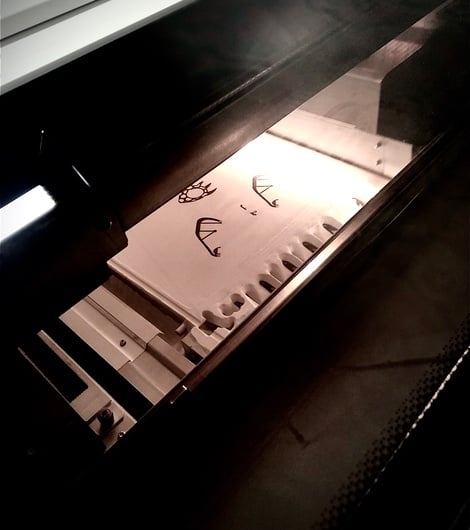
HP Multi Jet Fusion 3D Printing Machine Running

HP Multi Jet Fusion 3D Printing Process

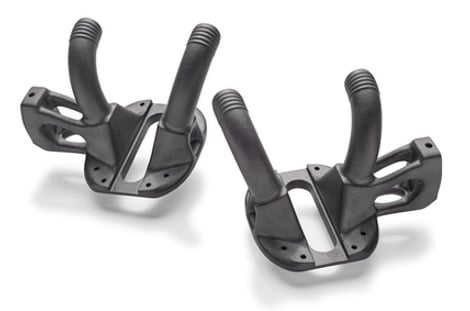
Parts manufactured by HP Multi Jet Fusion 3D printing

Parts manufactured using HP Multi Jet Fusion 3D printing are produced through an inkjet-style process that deposits fusing and detailing agents to control voxels within the powder bed. These agents are selectively fused into a solid layer, and the process repeats until the entire build is complete.

After the build finishes, the powder bed is cooled and transferred to a processing station where excess powder is removed and recycled.

Similar to SLS, HP MJF additive manufacturing does not require support structures during printing. Unlike fused deposition modeling (FDM) or stereolithography (SLA), parts are built within a powder bed that supports the geometry during the build process.

This ability allows parts to be nested within the build chamber, increasing production efficiency by maximizing build capacity, reducing material usage, and eliminating time-consuming support removal.

In the end, HP MJF parts are production-ready and can be post-processed to achieve custom finishes for applications across industries such as industrial equipment, consumer products, and automotive manufacturing.

HP MJF 3D Printing Benefits

  • Strong, tough, durable parts
  • Fine feature resolution and smooth surface finish
  • Thermoplastic materials, including Nylon, GF Nylon, PP, and TPU
  • Economies of scale with fast, nested prints
  • Isotropic mechanical properties
  • Ability to print complex organic shapes
  • Functional assemblies produced without supports.

HP MJF Best Uses

  • Replacement parts
  • Snap fits and living hinges
  • End-use production across various volumes
  • Air-tight and leak-proof components
  • Color printing applications

These capabilities make HP Multi Jet Fusion ideal for both rapid prototyping and production manufacturing.

MJF Production Professional logo_Blue Version_DMN - MJFPP logo_Blue


Ready to Get Started?

From design to prototype and production, our team of engineers is ready to help bring your idea to life with HP Multi Jet Fusion 3D printing and advanced additive manufacturing technologies.

Get a Quote

MJF Materials

HP MJF manufacturing builds parts using thermoplastic materials such as Nylon PA11, Nylon PA12, Glass Filled Nylon, PP, and TPU.

The most widely used material is Nylon PA12, available in both white and gray. This thermoplastic produces high-density, complex parts with excellent chemical resistance and dimensional accuracy.

When printing white or gray PA12 components, manufacturers benefit from strong consistency, uniformity, and repeatability from the first part to the last. White PA12 is especially useful for applications in medical devices and consumer products, as well as parts requiring vibrant post-processing color finishes.

The HP Multi Jet Fusion process also supports sustainability by refreshing the powder with recycled material to reduce production costs while maintaining part performance.

Learn more about the available MJF materials.

White parts can be custom finished to match prototype or production requirements through processes such as:
  • Dyeing
  • Vapor smoothing
  • Painting
  • Plating
  • HP color printing
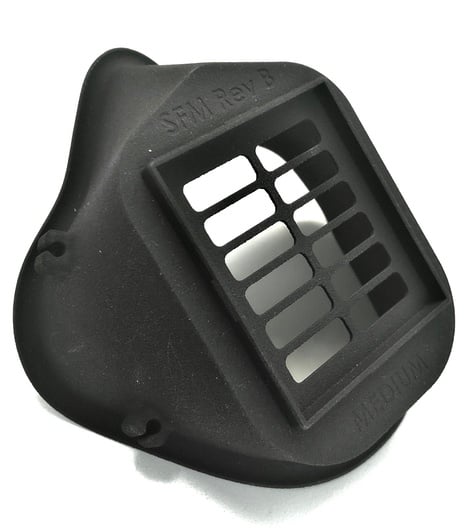
Mask manufactured by HP Multi Jet Fusion 3D printing

HP Multi Jet Fusion Equipment

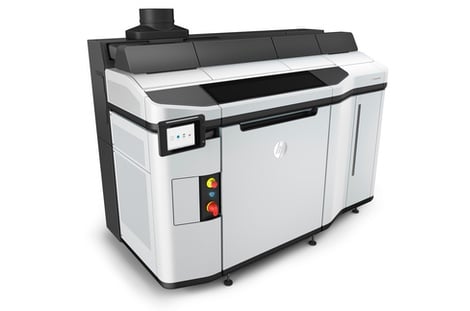
HP Jet Fusion 5200 3D Printer

HP Jet Fusion 5200 3D Printer

The HP Jet Fusion 5200 printer features a build volume of 380 × 284 × 380 mm (15” × 11.2” × 15”), large enough to produce most production and prototype parts.

A key advantage is its speed—a full build can print in roughly half a day and can be densely packed with multiple parts without support structures. This makes it ideal for both HP MJF 3D printing prototypes and scaled production runs.

Parts larger than the build volume can be sectioned into multiple pieces and assembled during post-processing.

The system is configured for production with multiple cooling stations and a processing station, allowing continuous operation while completed builds cool and parts are post-processed.

HP Jet Fusion 5420W

The HP Jet Fusion 5420W delivers consistent white parts with strong repeatability across production runs.

This printer is ideal for engineering-grade white production parts used in applications such as:

  • Medical devices
  • Consumer goods
  • Products requiring vibrant color finishing

The 5420W shares the same build volume of 380 × 284 × 380 mm and provides predictable print times for a wide range of geometries, without requiring support structures.

This HP Multi Jet Fusion 3D printing system delivers high-quality parts with excellent dimensional accuracy while maintaining low operational costs.

HP MJF Build & Design Guidelines

HP MJF offers excellent detail resolution, but like all additive manufacturing technologies, there are recommended design guidelines to ensure optimal results.

  • Build Layers = 80 microns (0.003”)
  • Minimum Wall Thickness & Feature Size = 0.5 mm (0.020”)
  • Standard Finish = Level 2 Finish with bead blast (custom finishes available)
  • Standard Lead Time = 3–5 days
  • Tolerances = ±0.010” for first inch, then ±0.003” per inch thereafter
  • Inserts = Installed during post-processing
  • Holes = Drill, ream, and tap after printing

What Our Partners Are Saying

I have partnered closely with TTH for over a year, and working with them has been a wonderful experience. Their entire team is always pleasant to work with, their project managers are incredibly knowledgeable, and their attention to quality and timeliness is best in class. I simply cannot recommend them highly enough for any project big or small.

- Jordan G., Additive Manufacturing Professional

Most of my 30 year career has been spent finding vendors that meet my Cost, Service, and Quality requirements. The number of suppliers that can meet those criteria for a sustainable period of time are few. TTH is one of those companies. The management team at TTH is always willing to work with us to improve efficiency and offer solutions that exceed our expectations. If you are looking for a partner, not just a supplier, the team at TTH will not disappoint.

- Tom C., NPI Materials Leader

Design Without Restriction

See how we partnered with Vitamix and Carbon to redefine what's possible. We took a legacy, six-piece, injection-molded part design and turned it into a new, one-piece, 3D-printed part.

We'd Love to Hear from You

Our experts have a proven history of providing innovative solutions at every stage of product development—from product design through production.


Let's Collaborate

Frequently Asked Questions

Q: What is HP Multi Jet Fusion (HP MJF) 3D printing?
A: HP Multi Jet Fusion (MJF) is an advanced additive manufacturing technology that uses precise deposition of fusing and detailing agents with heat to produce strong, accurate, and functional 3D printed parts. MJF can produce complex geometries with excellent mechanical properties and consistent quality across builds.

Q: What types of parts can be produced with HP MJF 3D printing?
A: HP MJF is ideal for functional prototypes, production components, jigs and fixtures, end‑use parts, and assemblies. The process delivers high strength, durability, and fine detail — making it suitable for engineering applications and low‑volume production runs.

Q: How does HP Multi Jet Fusion differ from other 3D printing methods?
A: Unlike some other additive manufacturing technologies, HP MJF fuses entire layers simultaneously, which results in faster build times, uniform mechanical properties, and excellent surface finish. It also produces repeatable parts with tight tolerances and material performance close to injection molded plastics.

Q: Why choose The Technology House for HP MJF parts and services?
A: TTH offers HP Multi Jet Fusion services backed by engineering expertise, robust quality systems, and customer support throughout the development process. TTH can help optimize your part designs for MJF and deliver reliable, high‑performance 3D printed parts tailored to your application.


Get Your Product to Market

Our integrated approach to design, prototyping, and production allows you to bring your concept to market faster and more cost-effectively than virtually anyone else.

Bring Your Idea to Life