

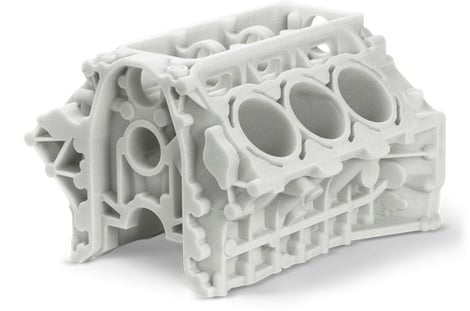
SLS is a powder-bed additive manufacturing process that uses a high-powered laser to fuse thermoplastic powder into solid 3D parts. This selective laser sintering 3D printing method is widely used for both prototyping and production because it produces strong, functional components without support structures.
The process is similar to stereolithography (SLA) in that it uses a laser to form parts layer by layer. However, SLS 3D printing uses powdered material instead of liquid resin. Like HP Multi Jet Fusion (MJF), SLS allows parts to be nested throughout the build chamber, enabling multiple components to be produced in a single build.
Parts manufactured using rapid prototyping typically use nylon materials such as PA11, PA12, and glass-filled nylon. Because of the specialized equipment and powder handling systems required, SLS printers are primarily used by industrial manufacturers and SLS 3D printing service providers.
For more than two decades, SLS has been one of the most widely used additive manufacturing processes for durable production components. The Technology House (TTH) has the capabilities to manufacture both prototypes and production parts through professional selective laser sintering services.
SLS 3D printing works by generating a 3D model from a CAD file and using a high-powered laser to sinter, or fuse, tiny particles of thermoplastic powder together layer by layer.
After each layer is fused, the powder bed lowers, and the next layer is applied. Because the surrounding powder supports the part during the build, SLS does not require additional support structures.
Once printing is complete, the parts cool within the powder bed before being transferred to a breakout station, where excess powder is removed and recycled.
This efficient powder-bed system allows multiple SLS 3D printed parts to be produced simultaneously, improving throughput and reducing material waste.
SLS 3D Printing Advantages
SLS Best Uses
These advantages make selective laser sintering services ideal for functional prototypes and end-use parts.
Not sure which additive manufacturing process is best for your application? At TTH, we offer a wide range of technologies, including Carbon DLS, stereolithography (SLA), PolyJet, fused deposition modeling (FDM), and HP Multi Jet Fusion (MJF), allowing us to produce parts with custom finishes that closely match production-ready components.
The most common materials used in selective laser sintering 3D printing are nylon-based thermoplastics. These materials provide excellent strength, durability, and chemical resistance.
Common materials include:
While these materials meet the needs of most applications, additional materials may be available depending on project requirements. Your project manager can help determine the best option for your application.
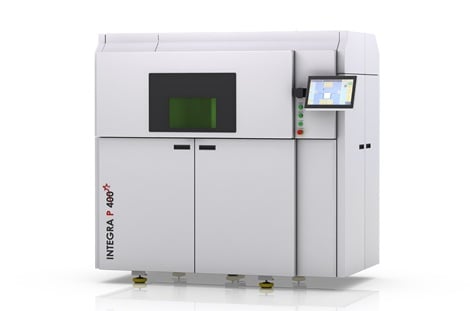
There are several industrial selective laser sintering machines available, most commonly produced by manufacturers such as 3D Systems and EOS, both long-standing leaders in additive manufacturing equipment.
These systems offer varying build volumes depending on the materials used. Larger platforms around 19” × 19” × 17” (480 × 480 × 430 mm) are typically used for Nylon PA12 parts, while smaller build chambers around 10.6” × 12.6” × 16” (270 × 320 × 410 mm) are commonly used for specialized materials such as glass-filled nylon, TPU, and PA11.
These machines are well-suited for producing large components or batch builds containing multiple smaller parts.
Each additive manufacturing technology has its own design considerations. Below are common guidelines when using selective laser sintering services.
I have partnered closely with TTH for over a year, and working with them has been a wonderful experience. Their entire team is always pleasant to work with, their project managers are incredibly knowledgeable, and their attention to quality and timeliness is best in class. I simply cannot recommend them highly enough for any project big or small.
- Jordan G., Additive Manufacturing Professional
Most of my 30 year career has been spent finding vendors that meet my Cost, Service, and Quality requirements. The number of suppliers that can meet those criteria for a sustainable period of time are few. TTH is one of those companies. The management team at TTH is always willing to work with us to improve efficiency and offer solutions that exceed our expectations. If you are looking for a partner, not just a supplier, the team at TTH will not disappoint.
- Tom C., NPI Materials Leader
See how we partnered with Vitamix and Carbon to redefine what’s possible. We took a legacy, six-piece, injection-molded part design and turned it into a new, one-piece, 3D-printed part.
Q: What are selective laser sintering (SLS) 3D printing services?
A: Selective laser sintering (SLS) is an additive manufacturing process that uses a high‑powered laser to fuse powdered material layer by layer into solid parts. TTH’s SLS services deliver strong, functional prototypes and end‑use components with excellent mechanical properties and complex geometries.
Q: How does SLS 3D printing differ from other 3D printing methods?
A: Unlike some other 3D printing technologies, SLS doesn’t require support structures because unfused powder naturally supports the part during printing. This makes SLS ideal for complex shapes, interlocking features, and durable parts used in engineering applications and functional testing.
Q: What types of parts can be produced with rapid prototyping selective laser sintering?
A: Rapid prototyping with SLS can produce functional prototypes, fit‑form testing models, production components, and custom parts for engineering validation. SLS parts tend to have robust mechanical strength, making them suitable for both prototyping and low‑volume production runs.
Our integrated approach to design, prototyping, and production allows you to bring your concept to market faster and more cost-effectively than virtually anyone else.
Headquarters
10036 Aurora-Hudson Road
Streetsboro, OH 44241
© 2026 The Technology House | Website by SyncShow | Privacy Policy